Published on The New Republic (http://www.tnr.com)
The Shah of Venezuela. The ideas that keep Hugo Chavez in power, and their disastrous consequences.
Enrique Krauze . April 1, 2009 12:00 am
I
The sacralization of history is an ancient practice in Latin America. In the region's Catholic countries, stories of the past, with their heroes and their villains, became instant paraphrases of the Holy Story, complete with martyrologies, holy days, and iconic representations of secular saints. But in Venezuela, where the presence of the church has been less rich and influential than in Mexico, Peru, or Ecuador, the transference of the sacred to the profane has been more intense, perhaps because of the lack of "competition" with strictly religious inspirations such as the Virgin of Guadalupe or the patron saints of Mexican towns. Venezuela's civic worship is unusual also in that it is monotheistic, which is to say, it has centered on the passion story of a man elevated to godhood. That man is Simon Bolivar.
In addition to parades, speeches, ceremonies, competitions, inaugurations, commemorations, unveilings of monuments, official publications, and other formal events in veneration of Bolivar that successive Venezuelan governments (oligarchic, civil, military, dictatorships) have produced, there arose a spontaneous and enduring popular cult of Bolivar already in 1842, just twelve years after his death. It was stoked by a kind of collective penitence for the sin of letting Bolivar die on Colombian soil. And so the liberator came to be relentlessly exalted by the same nation that, by rejecting his project for a Gran Colombia (which would have unified Venezuela, Colombia, Ecuador, and Panama), caused him to be ostracized. This Caribbean version of Moses and Monotheism was nicely codified by the Cardinal of Caracas in 1980, who declared from the seat of his diocese that all of Venezuela's misfortunes, the countless civil wars and the dictatorships of the nineteenth and twentieth centuries, all sprang from the "treason" that was originally committed against Bolivar.
Official, popular, manufactured, spontaneous, classical, romantic, nationalist, internationalist, military, civil, religious, mythic, Venezuelan, Andean, Ibero-American, Pan-American, universal: the cult of Bolivar became the common bond of Venezuelans, the sacrament of their society. Other sanctified heroes shared the altar, but they stood in Bolivar's shadow, and they were not always beloved: Francisco de Miranda, an early champion of independence; Antonio Jose de Sucre, Bolivar's loyal grand marshal; and General Jose Antonio Paez (Bolivar's right hand in war, his adversary in peace, and the founder of the Republic of Venezuela). Even in scholarly circles his immaculate image prevailed until the 1960s. When, in 1916, a young doctor dared to suggest that Bolivar was probably an epileptic, the censure of this act of "patriotic atheism" against the Bolivarian faith--an "august, admirable, sublime religion"--was harsh. "How is it possible," it was said, "that a Venezuelan should ascend to the empyrean to remove Bolivar from Caesar's side, and relegate him to the inferno, beside Caligula?"
From a very young age, Hugo Chavez revered Simon Bolivar. And not just Bolivar. In his modest childhood in the small western plains city of Barinas, Chavez also intensely admired Chavez--that is, Chavez "El Latigo," or The Whip, a famous pitcher who was killed in a plane crash after a brief career in the major leagues. According to his own telling of his life story, when he entered the Military Academy in 1971, at the age of seventeen, Chavez visited the tomb of El Latigo to ask forgiveness, because new heroes were demanding his attention: Che Guevara and Fidel Castro. Chavez was always a hero-worshipper. His personal pantheon included Ezequiel Zamora (the popular leader in the Federal War in the mid-nineteenth century) and his own great-grandfather, a bandit-rebel whose hazy career dated to the beginning of the twentieth century.
In Chavez's fevered imagination, the interesting thing about this past populated with heroes was that they spoke directly to him and ended up being reincarnated in him. "Let me tell you something I've never told anyone," he confessed to several friends. "I'm the reincarnation of Ezequiel Zamora." (Some say he has always feared he would come to the same end: betrayed and shot in the head.) With his contemporary heroes, too, Chavez needed direct contact, a laying on of hands. In an interview in 2005, he recalled his first encounters with Fidel. "My God, I want to meet Fidel when I get out and I'm free to talk," he prayed in prison, after his failed coup attempt in February 1992, "to tell him who I am and what I think." Their first meeting took place in Havana in December 1994. Castro stood waiting for him in person at the foot of the steps of his airplane. From then on, Chavez came to see him "as a father," and his children saw him as a grandfather.
The day he came to visit Grandma's little house in Sabaneta, he had to stoop. It's a low door, and he's a giant. I saw it with my own eyes, didn't I? And I remarked on it to [my brother] Adan.
Seeing him there, as if it was a dream: "this is like something out of a Garcia Marquez novel." In other words, forty years after the first time I heard the name Fidel Castro, there he was in the house where we were raised.... My God!
Garcia Marquez, indeed. During the fifteen years in which he patiently plotted his revolutionary conspiracy, forging his mystical links between his own genealogy and the nation's heroes, Hugo Chavez made himself into a kind of creature of magical realism. He would be the redemption, the climax, the supreme text prophesied by other texts, of the Sacred Writ of Venezuelan history.
Chavez the cadet was a celebrant of the Bolivarian passion story. In 1974, as testified in his writings collected in 1992 under the title Un brazalete tricolor , or A Three-Colored Armband, his outbursts of lyricism about the liberator went beyond the reverential imagery (pictorial, verbal, sculptural) of neoclassical history, beyond the romantic and patriotic equation of Bolivar with Alexander, Caesar, or Napoleon, beyond even the grandiloquent official images of "the apotheosis of the demigod of South America." In that year the inflamed cadet wrote an encomium for the hero that began with this curious sentence: "On June 23, on the eve of the anniversary of the great Battle ... of Carabobo, Simon Bolivar gave birth to the nation." As the Venezuelan historian Elias Pino Iturrieta has explained, Bolivar was, for young Chavez, God the Father, and the nation was the Virgin, and the Christ child was the army of liberation, which, in a leap across the centuries, was the same army to which Chavez belonged. In 1978, this florid notion would produce a natural corollary: that the Bolivarian army would return to the historical scene to restore the honor "of the humiliated mother," and bring continuity to the independence movement, and complete the work:
It [the army] is your child, Venezuela--and it gathers the people of the nation to its breast to instruct them and teach them to love and defend you ... It's your seed, Motherland.... It's your reflection, country of heroes ... your glorious reflection. As the years go by, our Army must be the inevitable projection of our country's social, economic, political, and cultural development.
On December 17, 1983, the anniversary of Bolivar's death, Chavez gave a provocative speech that earned him a reprimand from his superiors and was soon followed by the staging of a scene that has become famous in Venezuela: the oath of the Saman de Guerre. He urged four of his friends to put on a theatrical performance in which he connected his revolutionary project to the memory of the national hero. Under a very old tree, the Saman de Guerre, beneath which, according to legend, Bolivar once sat to rest, he repeated the oath that Bolivar took in 1805, in the presence of his mentor Simon Rodriguez, at Rome's Monte Sacro: "I swear by the God of my fathers, I swear by my country, I swear on my honor, that my soul will not be at peace nor my arm at rest until I see the chains broken that bind us and bind the nation under the powerful." In this way, 1805 became 1983. Chavez changed only two words: instead of "the powerful, " Bolivar's oration had made reference only to "Spanish power."
In the military exercises that he led, Chavez ordered his subordinates to begin the day with a thought selected at random from a book of Bolivar's sayings, and he repeated these phrases like quotations from a timeless and all-purpose gospel. His revolutionary movement had the same initials as Bolivar. In the first interview that he gave after his coup, gazing out from prison at the National Pantheon under whose main altar the remains of his hero rest, the Comandante uttered these words: "Bolivar and I led a coup d'etat. Bolivar and I want the country to change." Those were not metaphors. The Comandante was speaking in earnest.
Upon leaving prison in 1994, roused by the historic imagery incarnated in him, Chavez threw himself into the political activism that five years later would lead him to the presidency by the electoral route. But something disconcerting began to happen at meetings: an empty chair would be set at the head of the table, and Chavez would sit and stare at it. Only he could hear the voice of his invisible guest, the miraculous participant in his convocations. The empty chair of Bolivar the Liberator became a commonplace in Chavez's delirious universe.
This admiration for Bolivar was genuine, but the management of the myth was cunning and carefully considered. In interviews from the period, Chavez referred to the "mystification" of which "Bolivar the man" was the object. He then proclaimed himself "a revolutionary first and a Bolivarian second." Yet his revolution needed an "ideology," and he needed one, too. "But time is short. " What to do? At the very least there had to be an "ideological banner." He found it in his own cult of the hero. The Nicaraguan revolutionaries had adopted the figure of Augusto Cesar Sandino, the legendary nationalist guerrilla of the 1920s. In Mexico, Subcomandante Marcos had recently invoked Emiliano Zapata with great success. But Bolivar meant much more to the nation of Venezuela: he was more than a hero, he was a demigod. Without mincing words, Chavez declared: "If the myth of Bolivar helps to get people and ideas moving, that's good...."
In Latin America , poets are prophets. In February 1999, when he took office, Chavez quoted a famous line from Pablo Neruda, and made it the linchpin of his address, and built around it the most impressive theological-political performance ever seen in Latin America. In this sermon, an extremely long text larded with Bolivar quotations applied to the present day, full of religious shadings and grandiloquent turns that were extreme even by the permissive standards of Latin American rhetoric, Chavez heralded (in the Christian sense) his arrival in power as something greater than just an electoral or political or even historical triumph. It was still more: a parousia , the return to life of the dead and of the nation, the resurrection announced by the apostle Pablo (Neruda): "It is Bolivar coming back to life every hundred years. He awakes every hundred years when the people awake."
Later in the same speech, Chavez returned to the old idea of a primal deicidal guilt, tying it to his country's overwhelming poverty, and decreeing a new historical truth: the republic that was born in 1830 by "betraying the Condor" (another of Bolivar's holy names) had brought down upon itself a curse that lasted nearly 170 years. The complexities of Venezuela's republican past--which, despite wars and dictatorships, had also known periods of true civic freedom and material progress--disappeared completely, tossed out along with the electoral democracy that against all odds had been working quite well since 1959. For Chavez, that "ruinous political model" had to die. And so Venezuela was now contemplating the greatest of miracles--the "return of the Condor," the "resurrection ... that is nothing less than the continuation of the social revolution under the bright guiding light of Bolivar."
This was the promulgation of a new Bolivar, a revolutionary Bolivar, even a socialist Bolivar. The first civic rite of this "national re-founding" was a baptism of the nation blessed by the presence of Bolivar incarnate, "our infinite Father," "genius of America," "shining star," "shaper of republics," "truly great hero of our times," "true owner of this process." In dedication to him, Chavez declared, the Republic of Venezuela would add the word "Bolivarian" to its name, and the new constitution would be "based on the doctrine of Bolivar," omniscient, eternal, infallible.
From then on, the ceremonies of the cult of Bolivar--in official propaganda, in the media, in the marketplace--would become increasingly lurid. The Chavista masses would gather in the plazas of Caracas to stage the scene of the oath of the Saman de Guerre. They would chant " Alerta, alerta, alerta, Bolivar's sword is crossing Latin America! Bolivar lives, Bolivar is alive!" They would hear Bolivar, in a kind of collective parapsychological trance, speaking his opinion across the centuries on every subject: oil, the workers' movement, the social revolution, the virtues of socialism. They would begin to shop for "Bolivarian" plantains and rice, and buy "Bolivarian" chickens, and cut their hair at "Bolivarian" barbershops. "We have boldly sought a new frame of reference," explained Chavez, in interviews he gave in the 1990s. "Original and all our own: Bolivarianism."
Chavez's unquestionable "boldness" has been the subject of a number of anthropological studies that attempt to explain its success. Some anthropologists attribute it to the thaumaturgical nature of the Bolivarian cult in certain segments of Venezuelan society. Pino Iturrieta has collected incredible accounts of these secret and magical Bolivars: the Bolivar possessed by the spirit of a supernatural being gifted with powers of healing and salvation, called Yankay; the Bolivar of popular legend, the purported son of a black slave woman from the cocoa plantations; the Bolivar of liberation theology, who died poor and promises redemption for the dispossessed; the syncretistic Bolivar of Venezuela's old African religions, who occupies the center of a "Liberationist Court" presided over by Queen Maria Lionza, Venezuela's main female saint, worshiped by those who seek love, health, money, luck. In animist ceremonies, the shamans invoke Bolivar to curse "political parties," to bring equality, peace, and liberation, to "bless the neighborhood guerrillas and proclaim a kingdom of happIness ruled by the military."
Imbued with these fantastic strains of popular religiosity, and exploiting them for his cause, Chavez has continued to play the role of magician and thaumaturg, messiah and saint--but his most audacious move was to promote the Bolivarian cult by setting himself in the place of High Priest, in this way availing himself of Bolivar's charisma. In the history of Christianity, Pino Iturrieta found a fitting metaphor for what Chavez accomplished: "Now a tropical Constantine has imposed the complete identification of a people with a national god."
II.
To what political tradition does Hugo Chavez's Bolivarian delirium belong? According to his own version, his destiny was revealed to him around 1977, when he read a book. It was, of all books, The Role of the Individual in History by Georgi Plekhanov. He has more than once told the story of his great moment of inspiration, his epiphany before the text: "I read Plekhanov a long time ago, when I belonged to an anti-guerrilla unit in the mountains ... and it made a deep impression on me. I remember that it was a wonderful starry night in the mountains and I read it in my tent by the light of a flashlight." Again and again he turned to it "in search of ideas [about] the role of the individual in historical processes." He still has in his possession the "little book that survived storms and the years; the same little book with the same little underlinings a person makes, and the same little arrows and the same cover I used as camouflage so that my superiors wouldn't say 'what are you doing reading that?' I read it all over the place, in secret, with a flashlight at night."
"He read everything," said Herma Marksman, his mistress in the 1980s, "but he especially liked the stories of great leaders." The stories--and the theories, too. In an interview in 1995, Chavez remarked that "we men can situate ourselves ... in leading roles that speed or slow the process, give it a small personal touch.... But I think that history is the product of the collective being of the people. And I feel myself absolutely given over to that collective being." In colloquial terms, he has often referred to himself as a mere "instrument of the collective being." This is a highly idiosyncratic use of Plekhanov, but with it Chavez crafted his argument for the rule of the caudillo: "If they [the caudillos] develop a real awareness, they become removed from themselves and view the process from a distance. If they devote their lives, their efforts, to use their 'mythical' power to collectivize ... then the presence of the caudillo can be justified."
This theory of the individual in history, which is really a theory of the great man in history, explained his admiration for Castro. Although at the time he still wondered whether it was "a curse or a spreading virus" for the historical process to rely on a single man, on his visit to Cuba in 1995 Chavez was deeply moved by the way the people identified with the leader, the "collective" with the caudillo. A woman at a restaurant in the east of the island recognized Chavez and hugged him: "You talked to the chief, you talked to Fidel." For Chavez, "that is the people's message, I get everything I need straight from the people, the people on the street." This "message" that he regards as "all-important" is not the people speaking on behalf of the people, but the people speaking on behalf of the leader. Where was Plekhanov in all this? Chavez had no doubt: it was sufficient for the leader sincerely to declare himself the humble servant of the collective, and for the collective sincerely to accept him as its leader, for "the role of the individual in history" to be fulfilled.
In practice, though, what was the "collective"? Did it have significant parts, or was it a homogeneous whole? And were those parts free to form judgments? Could they disagree with the caudillo? Was there a way of measuring how well the caudillo served the "collective"? Could the "collective" choose another caudillo, or no caudillo at all? These questions did not occur to the ambitious soldier. The important thing was the mystical union of the many and the one, the dissolving of the collective in the leader. That was why it seemed natural and even desirable to Chavez that Castro had "enormous influence over the island": "generations have gotten used to Fidel doing everything. Without Fidel they would be lost. He's everything to them." Castro was an example of the lofty way in which caudillos "are detached from their person, they view the process from a distance and devote their lives to collectivizing through the use of their 'mythical' power." Castro had the historical right to be "everything": he was, after all, a hero--the great hero of Latin America.
Chavez also proposed to "detach himself," in the same way that Castro had detached himself for almost fifty years. For he was a hero, too--maybe not a conquering hero, a triumphant and legendary guerrilla like Fidel, but still a soldier with the heart of a guerrilla. He, too, proposed to "[collectivize] through the use of [his] mythical power": "The body of the nation is in pieces. The hands over here, the legs over there, the head on the other side of the mountains, the body of what we call the collective. Now, to go through life and get something done about putting that body back together, joining the hands to the arms and bringing it to life, giving the people, the collective, an engine, I think that's a life worth living." He had no idea, of course, that with this corporeal metaphor he was reviving one of the oldest conceits of absolute monarchical power. His mistress noted that a "messianic glow" had descended upon her lover. According to another revolutionary friend, Chavez "was convinced that he was carrying out an earthly mission guided by a superhuman force." His faint protests against such grandiosity hardly refuted this notion: "I don't believe in messiahs or caudillos, although people say that's what I am, I don't know whether I am or not, maybe there's a little bit of that in me.... "
President Chavez has been an assiduous reader of Plekhanov, but perhaps not the best reader. I suspect that he does not know much about Plekhanov's place in history. Georgi V. Plekhanov, who was born in Gudalovka, Russia, in 1856 and died in exile in 1918, was considered the father of Russian Marxism. He wrote his book around 1898, during the honeymoon period of his relationship with his disciple Lenin, with whom he edited the journal Iskra. Originally a Bakunian populist, Plekhanov fled czarist Russia in 1880, taking refuge in Geneva. He would not set foot on Russian soil again until 1917. It was he who coined the term "dialectical materialism." Plekhanov believed that there were immutable laws of history, and he thought that if Russia followed the same trajectory as the countries of Western Europe, it would emerge from feudalism into a state of mature capitalism, which was the necessary condition for its inevitable evolution into the salvific dictatorship of the proletariat. In 1889 he made his first appearance at the Congress of the Second International. In 1895, Lenin traveled to Switzerland to meet him.
Following the lead of Thomas Carlyle, Plekhanov believed in the existence of "great men" as initiators or originators. "This is a very apt description," he wrote. "A great man is precisely a beginner because he sees further than others, and desires things more strongly than others." In this sense, the great man is a hero "not ... in the sense that he can stop, or change, the natural course of things, but in the sense that his activities are the conscious and free expression of this inevitable and unconscious course." The leader is the supreme instrument of history's search for its conclusion. His freedom consists in his ability to choose a course of action in accordance with the fixed laws of historical progress:
[I]f I know in what direction social relations are changing owing to given changes in the social-economic process of production, I also know in what direction social mentality is changing; consequently, I am able to influence it. Influencing social mentality means influencing historical events. Hence, in a certain sense, I can make history, and there is no need for me to wait while "it is being made."
Plekhanov's concept of the "individual's role in history" might have been inspired by Hegel, who in his Philosophy of History speaks of "world-historical men." These beings with an essential role in the development of Spirit, these visionary agents of History, are followed by their inferiors, who "feel the irresistible power of their own inner Spirit thus embodied." From this metaphysical-authoritarian premise Hegel concluded that the ordinary rules of ethics were not applicable to great men. "Heroic coercion," he noted in his Philosophy of Right , "is justified coercion." The moral equivalence of might and right was also a key doctrine of Carlyle's: "Might and Right," he wrote in 1839, "so frightfully discrepant at first, are ever in the long run one and the same."
Lenin certainly agreed. But Plekhanov did not agree; and this was the irreparable difference between them. Against the backdrop of the Second International in Brussels in 1903, the disagreement between the two grew deeper, and led finally to a break. Lenin assumed absolute leadership of the movement, with the support of the group that would be known as the "Bolsheviks." "This is the cloth from which Robespierres are cut," thundered Plekhanov, who would accuse them of "mistaking the dictatorship of the proletariat for a dictatorship over the proletariat." Shortly afterward he gave up the editorship of Iskra , leaving it in Lenin's hands. His final article was a prophetic j'accuse titled "Centralism or Bonapartism":
Let us imagine that the Central Committee, recognized by all of us, had the right, still under consideration, of "liquidation." The following could then occur. A congress is convened, the Central Committee "liquidates" the elements with which it is displeased, selects at the same time the creatures with which it is pleased, and with them makes up all the committees, thus guaranteeing itself without further ado an entirely submissive majority at the congress. The congress composed of the creatures of the Central Committee affably shouts "Hurrah!," approves all its acts, good or bad, and applauds all its projects and initiatives. In such a case, the party would really have neither a majority nor a minority, because we should have put into practice the political ideal of the Shah of Persia.
Over the following years, Plekhanov grew more and more isolated, perplexed by the new phenomenon of absolute power concentrated in a vanguard party, itself commanded by a person beyond appeal, a "Shah of Persia." This phenomenon struck him as contrary to the laws of history. That was why he called Lenin the "alchemist of the revolution" and considered him a "demagogue from head to toe. " But such a concentration of power in a leader also seemed to him an assault on the humanist principles of socialism. In The Role of the Individual in History , Plekhanov declared that "it is not only for 'initiators,' not only for 'great' men that a broad field of activity is open. It is open for all those who have eyes to see, ears to hear and hearts to love their neighbours. The concept great is a relative concept. In the ethical sense every man is great who, to use the Biblical phrase, 'lays down his life for his friend.'" Plekhanov did not find this variety of greatness in Lenin.
In the standard manuals of MarxistLeninist theory, Plekhanov was a wrong-headed dissident. According to Lenin, the attitude of his old ally was "the height of vulgarity and baseness." Outside of that petrified orthodoxy, which lives today only in Cuba, Plekhanov is remembered as the first leading intellectual before Trotsky to warn against the horror of Marxism-Leninism. He supported Kerensky, just months before his death. Of Lenin, he said in his Political Testament that "not understanding the true goal of that maximalist fanatic was my greatest mistake."
If Plekhanov had lived until the end of the twentieth century, chances are that his view of Castro would have been exactly the same as his view of Lenin. He would have criticized the caudillo who is "everything" and denounced the Shah of Cuba. The Plekhanov who fought for humanist values, the Plekhanov who refused to subordinate society to its leader and represented the classic Marxist critique of the dictatorial spirit of Lenin and Leninism, is not the Plekhanov whom Comandante Chavez has been reading for thirty years. He may consider himself a Plekhanovist, but Plekhanov, it is certain, would not have been a Chavista. He would have despised the Shah of Venezuela.
And judging by his political writings, Plekhanov's teacher would not have been a Chavista either. In Marx's famous attack on Bonapartism, in The Eighteenth Brumaire of Louis Bonaparte , there is an unexpectedly direct connection to President Chavez's epic script. In London, around 1857, Marx received a request from his New York editor, Charles A. Dana, to write an article on Simon Bolivar for The New American Cyclopaedia . Although military affairs were Engels's specialty, and although he felt a strong distaste for what he regarded as the backward and barbarous countries of Hispanic America, Marx accepted the assignment. He wrote hastily, with his usual sarcasm, drawing on just a few sources, all hostile to the liberator. The final version of his biographical sketch made Dana uncomfortable, though he published it anyway in 1858.
In Marx's account, Bolivar is pictured as a yokel, a hypocrite, a clod, a womanizer, a traitor, a fickle friend, a wastrel, an aristocrat putting on republican airs, a liar, a climber who surrounded himself with the show of a court and whose few military successes were owed to the Irish and Hannoverian mercenaries whom he hired as advisers. That Marx's animosity toward Bolivar was almost personal is clear. In a letter to Engels he repeats his damning conclusions, calling Bolivar "the most dastardly, most miserable and meanest of blackguards," and compares him to Soulouque, the flamboyant Haitian caudillo who in 1852 had himself crowned emperor under the name Faustino I.
Marx's assault on Bolivar has always been a nightmare for the Latin American left. How to explain it? And what to do now that President Chavez has decreed Bolivar a prophet of "twentieth century socialism"? In 2007 a book was published in Caracas called El Bolivar de Marx , or Marx's Bolivar , which consists of side-by-side texts by serious Venezuelan writers of opposing views--the liberal historian Ines Quintero and the Marxist philosopher Vladimir Acosta, who conduct an elegant debate on the subject of Marx's portrait of Bolivar.
Quintero offers a history of the reception of Marx's text in Latin America, where the left has striven to understand it, to critique it, to play it down. Unfortunately, it has not sufficed to show that Marx's portrait of Bolivar is marred by factual errors, questionable psychological interpretations, sarcastic racist remarks, and hasty judgments. Uncomfortable and disturbing questions have always lingered. The orthodox proSoviet faction of the 1930s believed that the text was, of course, untouchable. After Stalin, a weak retraction came from the same Soviet camp: the infallible Marx had erred in this instance, because his sources were limited and biased. By then, several prominent leaders of the Latin American left had attempted to rehabilitate Bolivar for the left. And it was high time: for decades Bolivar had been the almost exclusive idol of the right, which claimed for its cause not only his deeds as liberator but also his growing conviction--amply documented in various acts, declarations, and constitutions (especially the Constitution of Bolivia of 1826, in which he proclaimed himself president for life)--that only dictatorship could bring order to the anarchic, violent, and ungovernable nations of Hispanic America.
Bolivar's dictatorial convictions, which were plain and strong by the last decade of his life, are what Marx condemned him for most vehemently. Between the lines of his piece on Bolivar one hears a clear echo of The Eighteenth Brumaire of Louis Bonaparte : "The constitution, the National Assembly, the dynastic parties, the blue and red republicans ... the thunder from the platform, the lightning bolts of the daily press, the entire literature, the political names and the intellectual reputations, the civil law and the penal code, libert?, egalit?, fraternit? ... all have vanished like a phantasmagoria before the spell of one man...." In his incisive essay on the text, Vladimir Acosta acknowledges this link. He notes also that by condemning Bolivar, Marx launched an assault not only on Bonapartism but also on Hegel. "An inveterate polemicist," says Acosta, "Marx turns his theoretical and political hatred of the Hegelian state and his empirical hatred of the Bonapartism incarnated in Napoleon III into personal hatred of Bolivar."
In Marx's article, there are direct and indirect allusions to Bolivar's authoritarianism. The word "dictatorship" appears in several places. At one point Marx makes scornful reference to Bolivar as the "Napoleon of the retreat. " And when he describes Bolivar's activities in Bolivia, the country that would bear his name, Marx writes:
Here, where Sucre's bayonets were supreme, Bolivar gave full scope to his propensities for arbitrary power, by introducing the "Bolivian Code," an imitation of the Code Napoleon. It was
his plan to transplant that code from Bolivia to Peru, and from Peru to Colombia.... What he really aimed at was the erection of the whole of South America into one federative republic, with himself as its dictator ... thus giving full scope to his dreams of attaching half a world to his name....
As Quintero documents, this authoritarian side of Bolivar had not just served as an ideological inspiration for the Latin American and Venezuelan right, but also for Italian and Spanish fascism. Both Mussolini and Franco identified themselves with Bolivar's Caesarism. And with their national hero expropriated by such forces of reaction, the Venezuelan left had a great need to rehabilitate him--but given its own authoritarian history, it did not have much to say on this point, and could only continue to cite the errors in the text or its Europeanist slant. Then a new apologetic strategy was found to re-claim the hero under the rubric of Ibero-Americanism, and gradually introduce an anti-imperialist Bolivar. The next step came with the rise to power of Hugo Chavez: "the Return of the Condor."
Up to this point, both Acosta and Quintero honor the empirical truth. But when they refer to the present day, and to the use that Chavez's regime makes of history, their views radically diverge, nicely reflecting the intellectual war that is now tearing Venezuela apart. Acosta explains Marx's reasons for attacking Bolivar, but he does not explain his own reasons for adopting Chavez's Bolivarian narrative. His omission leads him into contradiction. After justifying Bolivar's concentration of power in himself as a wartime imperative, Acosta maintains that historians "on the Right" have denied Bolivar his historicity--and then he immediately goes on to deny Bolivar the same protection by affirming Chavez's appropriation of the liberator. Acosta calls it a way of "rescuing for the people" the "human political greatness and enduring Ibero-American significance of Bolivar." He fails to note the resemblance between his president's "Bolivarian" project and the ahistorical and "sacralizing" perspective for which he takes the "rightists" to task.
In response, Ines Quintero cites a speech by President Chavez in which he scolds those who take Marx's Capital as gospel, divorced from its circumstances--"you have to realize, kid," said Chavez, "that this was written over there in 18something ... you have to realize that the world has changed"--and thereby exposes the contradiction implicit in the use that Chavez has tried to make of Bolivar as a prophet of twenty-first century socialism. Quintero provides concrete evidence of the "arbitrary, selective, and anachronistic use of Bolivar's discourse, heedless of the circumstances and historic specificity of his life."
This dispute between Acosta and Quintero is not academic. Acosta understands the use that Chavez makes of Bolivar, and defends it. In his rather Hegelian eyes, it is an objective and historic renewal of an old and interrupted process of continental liberation. For Quintero, the scandal is not just the ahistorical, fraudulent, and self-interested use that Chavez makes of Bolivar to justify his own power, but something more subtle: the growing political use to which he is put. "If Bolivar serves to justify the 'socialism of the twenty-first century,' he can just as usefully endorse the end of the democratic transfer of power and the installment of a dictatorial regime, based on the claim that the example and the word of the father of the nation are simply being heeded."
III.
'I don't know anything about Marxism, I never read El Capital , I'm not a Marxist or an anti-Marxist," Hugo Chavez said in 1995. He was telling the truth. Chavez was never, in any strict sense, a Marxist, nor was he familiar with the prickly side of Marx, or with his critique of power. Marx criticized the subordination of civil society to a single leader. He criticized the smothering of freedoms and political institutions, the "terrible parasitical organism" of the state, the cult of personality, demagoguery, and plebiscitary rule. And as if that were not enough, he criticized the political use of the past: "The social revolution of the nineteenth century cannot draw its poetry from the past, but only from the future.... In order to arrive at its own content, the revolution of the nineteenth century must let the dead bury its dead." Point by point, Marx's critique might have been written in response to Chavez's plan for Venezuela.
But if he does not hail from a socialist or Marxist tradition, what are Chavez's ideological and historical origins? Whether he knows it or not, Chavez is the grotesque progeny not of Plekhanov or Marx, but of Thomas Carlyle. It was Carlyle's historical and political doctrine, condensed in 1841 in the series of lectures published as On Heroes and Hero-Worship , that envisioned and legitimated charismatic power in the twentieth century, the same power that Chavez, for all his outlandishness, represents so skillfully in the twenty-first century. The wishes of his progressive post-Marxist admirers notwithstanding, Chavez comes from a more anachronistic tradition of ideas that does not see history in terms of the struggle of classes or masses, or of races or nations, but of heroes who guide the "people," who incarnate them and redeem them. There is a name for this tradition. It is fascism.
Bolivarian Venezuela and its maximum leader have a number of reasons to recognize themselves in Carlyle, and to forget all of Chavez's nonsense about Plekhanov and Marx. Unlike Marx, Carlyle admired Bolivar. In 1843, lamenting the lack of biographies of "the Washington of Colombia," Carlyle wrote this shining vignette about the national hero:
Melancholy lithographs represent to us a long-faced square-browed man: of stern, considerate, consciously considerate aspect, mildly aquiline form of nose, with terrible angularity of jaw, and dark deep eyes, somewhat too close together (for which latter circumstance we earnestly hope the lithograph alone is to blame); his is Liberator Bolivar, a man of much hard fighting, hard riding, of manifold achievements, distresses, heroisms and histrionisms in this world; a many-counselled, much-enduring man, now dead and gone; of whom, except that melancholy lithograph, the cultivated European public knows as good as nothing. Yet did he not fly hither and thither, often in the most desperate manner, with wild cavalry clad in blankets, with War of Liberation "to the death"? ....With such cavalry, and artillery and infantryto match, Bolivar has ridden, fighting all the way, through torrid deserts, hot mud-swamps, through ice-chasms beyond the curve of perpetual frost--more miles than Ulysses ever sailed; let the coming Homers take note of it.
He has marched over the Andes, more than once, a feat analogous to Hannibal's, and seemed to think little of it. Often beaten, banished from the firm land, he always returned again, truculently fought again. He gained in the Cumana regions the "immortal victory" of Carabobo and several others; under him was gained the finishing "immortal victory" of Ayacucho in Peru, where Old Spain, for the last time, burnt powder in those latitudes and then fled without return.
He was Dictator, Liberator, almost Emperor, if he had lived. Some three times over did he in solemn Columbian parliament lay down his Dictatorship with Washington eloquence, and as often, on pressing request, take it up again, being a man indispensable. Thrice, or at least twice,
did he, in different places, painfully construct a Free Constitution; consisting of "two chambers, and a supreme governor for life with liberty to name his successor," the reasonablest democratic constitution you could well construct; and twice, or at least once, did the people, on trial, declare it disagreeable. He was, of old, well known in Paris; in the dissolute, the philosophico-political, and other circles there. He has shone in many a gay Parisian soiree, this Simon Bolivar; and in his later years, in autumn 1825, he rode triumphant into Potosi and the fabulous Inca cities, with clouds of feathered Indians somersaulting and war-whooping around him,and "as the famed Cerro, metalliferous Mountain, came in sight, the bells all pealed out, and there was a thunder of artillery," says General Miller. If this is not a Ulysses, Polytlas and Polymetis, a much-enduring and many-counselled man, where was there one? Truly a Ulysses whose history were worth its ink, had the Homer that could do it made his appearance!
This Homeric notion of Bolivar, and the comparison of him to Washington (which Castro curiously reprised in a speech before Chavez), should earn Carlyle a Bolivarian statue in Caracas. But aside from this text on Bolivar, the relevance of Carlyle to the Bolivarian regime, and to the thinking of its maximum leader, lies in the concept of the hero as a central actor in history. Revolutions, Carlyle insisted, require a hero to give new meaning to collective life. On the subject of his transcendent faith in great men (which was inspired by Fichte, who maintained that the "Divine Idea" manifests itself in a few individuals), Carlyle coined his famous phrase: "'Hero-worship' becomes a fact inexpressibly precious; the most solacing fact one sees in the world at present. ... No sadder proof can be given by a man of his own littleness than disbelief in great men." And in Sartor Resartus he summed up his philosophy of history: "Great Men are the inspired (speaking and acting) Texts of that divine Book of Revelations, whereof a Chapter is completed from epoch to epoch, and by some named History; to which inspired Texts your numerous talented men, and your innumberable untalented men, are the better or worse exegetic Commentaries. ..."
In speech after speech by the maximum leader of the Bolivarian Revolution, the motifs that once represented Bolivar have been used to represent Chavez's greatest hero: himself. Chavez, too, believes in modern Latin American history as a Sacred Text populated by heroes on a holy and urgent mission, for which they are gifted with divine fire. In our time, they were Che and Fidel. Since he was a young man, Chavez has believed that the life story of his country--at least until his arrival, or the "national resurrection"--was Bolivar's life story. And in his self-apotheosizing inaugural address in 1999, one more life story was inscribed in the Sacred Text: his own.
The Comandante has believed all this with a tenacity and a fervor perhaps unprecedented in Latin American political history. In one of his first interviews after he was released from prison, he explained that "at a given moment, we men can situate ourselves in leading roles that speed or slow the process, give it a small personal touch, a distinctive touch. But I think that history is the product of the collective being of the people. And I feel myself absolutely given over to that collective being." So spoke Comandante Chavez in the antechambers of power. His dream was to give "a small personal touch, a distinctive touch" to the revolutionary process.
From the end of the nineteenth century, Carlyle was much quoted in Latin America. The positivist historical schools invoked him to justify the strongmen that the region--supposedly "ungovernable" by means of "Anglo-Saxon" democracy--needed to get ahead. In his famous work, Democracias latinas de Am?rica , or Latin Democracies of America , which appeared in 1900, the Peruvian historian Francisco Garcia Calderon found the heroic key to Latin American political history in Carlyle: he praised the dictators--the Argentinian Rozas, the Mexican Porfirio Diaz, the Ecuadorian Garcia Moreno--and saw them as incarnations of the history of their respective countries. Twenty years later, the Venezuelan sociologist Laureano Vallenilla Lanz published Cesarismo democratico, or Democratic Caesarism, a celebrated book in which he presented the theory of the "necessary gendarme," with reference to the Venezuelan dictator Juan Vicente Gomez, called "Carlyle's man" by the historian Jose Gil Fortoul. In the 1920s, another Venezuelan, the poet Jose Antonio Ramos Sucre, presented the Carlylean cult of the hero--indeed, the military hero--together with the cult of Bolivar.
But in the 1930s a new political dimension was added to the cult of the hero. It was Jorge Luis Borges who discovered a troubling key to Latin America in Carlyle. In 1917, as a young man, Borges learned German, inspired by Carlyle's Germanophilia. More than thirty years later, re-reading the last lecture in On Heroes and Hero-Worship , he noted that "Carlyle reasons like a South American dictator in his defense of the dissolution of the English parliament by Cromwell's musketeers." Borges was referring to the passage in which Carlyle describes how, in 1653, after the beheading of King Charles I, the Puritan revolutionary Oliver Cromwell--Carlyle's favorite hero--loses patience with Parliament, made up of "blind pedants" with their "constitution-formulas" and "right of Election," and finally dissolves it to become, with the "power of God, " the Lord Protector of England.
Borges read Carlyle with Latin American eyes, detecting Cromwell's resemblance to our anti-democratic prototypes: caudillos, revolutionaries, dictators. What is so remarkable is that the connection that Borges observed has its flipside in reality: Carlyle was himself inspired by Latin America. In the years in which he compiled the unpublished speeches of Cromwell, Carlyle bemoaned the fact that the nineteenth century had not produced a leader like that "great, earnest, sincere soul who always prayed before his great undertakings." "Our age shouted itself hoarse," Carlyle wrote, "bringing about confusion and catastrophe because no great man did heed our call." Then suddenly, around 1843, Carlyle stopped shouting himself hoarse, because he discovered by chance, in a remote South American country, a "hero" worthy of the name, a "savior of his age" a "phoenix of resurrection": Jose Gaspar Rodriguez Francia, the dictator of Paraguay.
The stirring example of Francia struck him so forcefully that he interrupted his work to undertake--based on a few reports by German travelers--the biography of that "one veracious man." Carlyle wrote just one biography of a contemporary: that of Doctor Francia. He called him the "Cromwell of South America," a "man sent by Heaven," a "fierce condor." He admired his firm and spiritual rule, his "Divine Offices in Paraguay," his severity, his scorn for the intellectual forms and political institutions of eighteenth-century rationalism: "Tawny-visaged, lean, inexorable Dr. Francia; claps you an embargo on all that [ballot boxes, registration courts, bursts of parliamentary eloquence]; says to constitutional liberty, in the most tyrannous manner, Hitherto, and no farther." Above all, Carlyle applauded the tyrant's desire to perpetuate himself: "My lease of Paraguay ... is for life," Francia had said. Through him, Carlyle declared, "Oliver Cromwell, dead two-hundred years ... now first begins to speak." A South American dictator had given Carlyle new faith in the present and future possibility of heroes.
In Carlyle's historical theology, Borges thought that he had found Carlyle's legacy to the twentieth century: a political theory that led men to prostrate themselves before the "God-intoxicated," before those beings "inspired" by God, before the "kings" by natural law, because they embodied the only hope of a new reality that could do away with the surrounding "shams." From the presumption that the hero is not just another leading player or a consequence of history but its cause, Borges extracted a political corollary: "once the divine mission of the hero has been postulated, it is inevitable that we judge him (and that he judge himself) free of human obligations.... It is also inevitable that every political adventurer believe himself a hero and that he reason that his excesses are irrefutable proof that he is one."
The date of Borges's text on Carlyle, a prologue to a translation of On Heroes and Hero-Worship , is significant: it was written in 1949. Four years after the end of World War II, Carlyle's theory seemed at last to divulge its ultimate meaning: "his contemporaries did not understand it," Borges wrote, "but now it may be summed up in a single household word: Nazism." And Borges was not alone in this observation. The same conclusion was reached by Chesterton, in The End of the Armistice , and by Russell, in "The Ancestry of Fascism," among others. (In 1981, Hugh Trevor-Roper also took up the argument in an essay on Carlyle's thought.) For Borges, not only Germany but also Russia and Italy had "drunk to the dregs" the "universal panacea" that he characterized as the "unconditional surrender of power to strong and silent men. " Correcting only for the fact that Evita--like Chavez, who erected a statue to her--was not exactly silent, Borges might have been able to add to his Carlylean list the Argentina of Peron. By 1949, though, he confessed that his love for the hero had become a deep hatred. The results of dictatorship, fascist or populist, were the same: "servility, fear, brutality, mental indigence, and treachery."
In his cult of Bolivar, at once sincere and calculated, and in his idolatry of history, Comandante Chavez is part of this intellectual lineage. In his political theology and in his political action, he is Carlyle's bloated and buffoonish son. The protagonist of his regime is not at all "the collective." As is evident to everyone in every corner of Venezuela, the protagonist of his regime is the "hero," the man himself, Hugo Chavez.
IV.
Is Chavez, then, a classical fascist? Even before he assumed power, Chavez defended the need for a charismatic leader: "The caudillo is the representative of a mass group with which he identifies, and he is recognized by that group without any formal or legal legitimizing process." And "this can only be called a revolution," he said in his inaugural address. As "a revolutionary first and a Bolivarian second," he preached the need to wipe clean the slate of the past from the time of Bolivar's death to his own rise, and he equated military dictatorship with "stinking democracy." For him, all of Venezuela's military regimes before his own were "essentially the same" as the democratic governments of Romulo Betancourt or Rafael Caldera: on horseback or in a Mercedes Benz, they all represented "the same prevailing economic and political thinking, the same denial of the people's right to take the leading role in their destiny." The revolution that he stood for would bury the "ruinous political model ... of the last forty years" and put the people back in charge of their fate. And how would they take charge of it? In the person of the leader, of course.
Those were the "bad" militaries. He represented the "good" ones. Nearly as important to Chavez as his revolutionary faith in a caudillo has been the matter of his military identity: "Our movement was born in the barracks. That's a factor we can never forget, it was born there and its roots are there." From the beginning it was clear that he adored military parades, and that he regarded the country and the society as military structures, orderly and hierarchical. As for the political value of myth, symbol, and ritual: "If the Bolivar myth helps to quicken people and ideas in accordance with a revolutionary process, well, the process will tell, because if [the myth] is good for anything, it should be for the transformation of a people, not their exploitation." The theological-political staging of the Bolivarian "resurrection" has been the ongoing spectacle of his rule, from his rise to power until the present day.
On the subject of liberal democracy, his opinions have always been sweeping: "Liberal democracy is no good, its time has passed, new models must be invented, new formulas.... Democracy is like a rotten mango: it has to be taken as seed and sowed." Regarding the opposition parties represented in parliament, Chavez went so far as to exclaim, at a rally before he was first elected, that "we, you and I, are going to roll the [social-democratic opposition] up in a giant ball of ... I can't say what because it's rude." And the crowd responded: "Of shit!" Years later he would declare that "the opposition will never return to power, by fair means or foul." On his visit to Cuba in 1999, he suggested that his presidency would last "twenty to forty years." And among the sixty-nine articles of his constitutional reform rejected by plebiscite in 2007 was the possibility of indefinite re-election, ensuring that his lease over Venezuela would be for life. Now, with the recent referendum, which many constitutional lawyers thought illegal, he may have achieved this tyrannical goal.
In devising his Bolivarian ideology, Chavez might not have read Carlyle, but he certainly read his "great friend," the Argentinian sociologist Norberto Ceresole. He met Ceresole after he was released from prison, traveled with him around Venezuela, and for many years the professor was a close advisor. Ceresole, who was born in 1943 and died in 2003, moved easily between the Soviet left and the neo-Nazi right. He was an advisor to Juan Velasco Alvarado; a member of the Montoneros, a Peronist guerrilla group; a spokesman for Peron during his exile in Madrid; a leader of the Carapintadas, an ultra-right military movement; a member of the Soviet Academy of Sciences and a professor at the Soviet Military Academy; a representative of Hezbollah in Madrid; a neo-Nazi militant and a vociferous Holocaust denier. Ceresole was the author of several books of geopolitics explicitly inspired by the Nazi general Karl Haushofer. And this brings us to another element of classical fascism that Hugo Chavez has not hesitated to exploit: anti-Semitism.
In his book Terrorismo fundamentalista judio , or Jewish Fundamentalist Terrorism, which was published in 1996, while he was associated with Chavez, Ceresole revived the theory of an international Jewish conspiracy actively set on seizing control of Latin America. Ceresole predicted that war would break out between Iran and the Washington-LondonTel Aviv axis. Unable to fight the battle alone, Iran would call to its aid a "large and powerful State" which "of course will be the German State." Then "Berlin will rise from its ashes and we will see the Phoenix soar." In its final apotheosis, Chavez's friend and favored intellectual predicted, the "German Empire" will ally itself with Russia, Japan, and the Muslim world. And in this replay of World War II, Latin America would free itself of the traditional historical encumbrance of "Anglo-America," and of its secret encumbrance, the "globalizing Jews" who have infiltrated the political structures of the region. Backed by "Eurasia," Latin America would expand its Lebensraum with a supranational army. (In 1995, Chavez declared that "we are studying the whole approach that Norberto Ceresole sets out in his studies and work.")
Chavez's mentor Ceresole would have been pleased by the invocation of a fascist lineage for his Comandante. In his work Caudillo, ejercito, pueblo: La Venezuela del Comandante Chavez, or The Caudillo, the Army and the People: The Venezuela of Comandante Chavez, which was published in 1999, Ceresole wrote:
"In Venezuela, the change will be channeled through one man, one "physical person," not an abstract idea or a party.... The people of Venezuela created a caudillo. The nucleus of power today lies precisely in the relationship established between the leader and the masses. The unique and differential nature of the Venezuelan process cannot be distorted or misinterpreted. What we have here is a people issuing an order to a chief, a caudillo, a military leader. "
This prophet of the "German Phoenix" and enemy of the infamous "Jews" Karl Marx and Adam Smith would have been untroubled by another feature of Chavez's dictatorial rule: the persecution of the Jewish community of Venezuela. In the Chavez years, and most nastily in recent months, the Venezuelan Jewish community has been the scapegoat of the theories that Chavez absorbed from Ceresole. Its schools and its institutions have been repeatedly raided by the police, and its members have been harassed by Chavista television, radio, press, Internet sites, and even by the President himself. The Jews of Venezuela have been denounced as the instigators of the coup attempt against Chavez in 2002. The theory of a "worldwide Jewish conspiracy" has become a commonplace in Venezuela. In the weeks leading up to the recent referendum, the old Mariperez Synagogue in Caracas was violently assaulted; the building was defaced and the computers that store information on the Jewish community of Venezuela were stolen. It is no coincidence that the Islamic Republic of Iran has found a staunch ally in the Bolivarian Republic of Venezuela. It is also no coincidence that in the Chavez years nearly 25 percent of the Jewish community--fifteen thousand people--should have decided to emigrate.
V.
'The history of the world," wrote Carlyle, "is but the biography of great men." "The history of Venezuela," Comandante Chavez suggested in 1999, "was the biography of Bolivar," as interpreted by his prophet on earth, Hugo Chavez. Ten years later, the Comandante might say that the history of Venezuela is but his own biography, the biography of Hugo Chavez.
Chavez's omnipotence is owed to his omnipresence. (The two qualities are often linked in deities.) Just watch him any Sunday on his show " Alo presidente "--its minimum duration is five hours--live from the palace of Miraflores. Presiding over his silent, acquiescent ministers, all dressed in red, the Comandante tells stories from his life, and yammers on about romantic adventures, gastric ailments, baseball games; he also sings, dances, recites, prays, laughs. In these sessions Chavez dictates electoral strategies, huge transfers of fiscal resources, petroleum subsidies, social initiatives, troop movements, diplomatic ruptures, busIness expropriations, cabinet changes. All of this has struck some American journalists--and movie people, such as Oliver Stone and Sean Penn--as folksy and authentic and even patriotic.
Chavez does not act like the president of Venezuela; he acts like its owner. He is the proprietor of his public office, the CEO of state enterprises that answer to no laws of transparency and accountability, the big and indiscriminate spender of oil revenues (between 1999 and 2008 he spent, on average, $122 million per day), the supreme leader of a Legislative Assembly and Tribunal of Justice that is supposed to serve as a check and a balance, the head of an attorney general's office that is supposed to oversee his actions, the comptroller of electoral organs that are supposed to be autonomous, the caudillo of official candidates who have no other ideology than his strange "twenty-first-century socialism" and no other loyalty than that which they owe him personally. But above all Chavez is the commander-in-chief of a media campaign that, in his mind, is the equivalent of a great and interminable military battle. Those who are not with him are "against Venezuela," are "imperialists," " pitiyanquis " (little Yankees), "filth."
Bolivar wanted to be president for life, but he declined the throne. He was present at the coronation of Napoleon, watched his rise and fall, and always detested monarchies. Chavez, by contrast, acts like a patrimonialist monarch. He has distributed posts, privileges, and money to his family. He has capriciously disposed of billions of dollars. He has headed a continental movement controlling--through the supply of oil at preferential prices and conditions--a number of Latin American countries (Bolivia, Nicaragua, Paraguay, Honduras, and Ecuador a bit less, and probably soon El Salvador) that now behave like his vice-royalties. He has dreamed of forging, along with his "Iranian and Arab brothers," the new hegemonic power of his time. And his kingdom is not only of this world: "Christ was communist," he has said repeatedly, to taunt the Catholic Church and the evangelical community.
How has this coarse megalomaniac managed to bestride the globe? His defenders explain it by the success of his social programs and the economic growth of recent years, noting the corruption of the regimes that preceded him and arguing that Chavez was democratically elected, which gives him a mandate that legitimates all his actions. And the social programs implemented through the different "missions" (subsidized food, free medical assistance, literacy training, and education) did in fact have a strong period of growth between 2004 and 2006. But by 2007 they were in decline, and their loss of credibility was perceptible: empty shelves in stores as well as problems of supply, staff, and quality in both medical and educational services. Wanting to bypass the state in his social and political outreach, Chavez made an inefficient, corrupt, and dependent bureaucratic monster of PDVSA, the oil company that in its day was world-class, and the ultimate result was the weakening of formal institutions before new ones could be consolidated.
The growth of per capita income in Venezuela--14.6 percent between 1999 and 2006--was attributable to oil revenues, but since 2007 income has fallen substantially due to inflation, which reached 31 percent in 2008 and was the second highest in the world after Zimbabwe. As for corruption, its magnitude is hard to measure given the system's total opacity. But there is external evidence: based on numbers from the Central Bank of Venezuela itself, of the $22.5 billion that left the country between 2004 and 2008, $12 billion were never accounted for. Something similar happened at PDVSA, with $5 billion vanishing in 2005. On the Corruption Perceptions Index released in 2008 by Transparency International, Venezuela was rated 158 out of 180.
The Chavista project--the unprecedented increase in public employment, the transfer of resources to allied countries, whether as direct handouts or oil-bill subsidies, the expropriation of strategic assets such as electricity, telecommunications, iron and steel, aluminum and cement--went hand in hand with the deliberate exclusion of private enterprise, which, unsurprisingly, reduced investment to historic lows. But the effect of this weakening of the means of production was postponed because the gap in supply was filled by unparalleled imports of consumer goods. Meanwhile PDVSA, stripped since 2003 of one-third of its professional workforce, saw its production and exports fall in 2008 by 34 percent and 50 percent, respectively. What was propping up the edifice? A single brick: the price of a barrel. Venezuela was immersed in the magical realism of an economy that produced less and consumed more, thanks to the exponential increase in oil prices, which between 2002 and 2008 went up by a multiple of seven, from $20 to $140 per barrel. In mid-2008, Chavez's ministers considered it "impossible" for the price to come down for the time being. The Comandante boasted that he could take the price to $250. He could do anything.
The price of oil supported this fiction until a few months ago. But the key to Chavez's enthronement lies not in his erratic record of economic development or in the arguable success of his social programs, but in the press's handling of his colossal persona. His takeover of the Bolivar myth is complete. All the fantastic strains of popular religiosity in Venezuela, its folk political theology, are now centered in him. Of course, demigods do not share power. That is why, from the moment he became president by the electoral route, Chavez has used democracy to undermine democracy. After achieving the unconditional subordination of all the constitutional powers, he has taken numerous measures to undermine all independent sources of power and to crush the opposition.
After the recall referendum in 2004, he introduced what the distinguished left-wing journalist Teodoro Petkoff has called "political apartheid"--job discrimination against, and the political harassment of, more than 2.3 million people who voted against him. In May 2007 he closed down RCTV, the main independent TV station. In 2008, he disqualified hundreds of possible opposition candidates from mayoral and gubernatorial elections. After the opposition's surprising gains in those elections, and knowing that the global economic crisis would soon reach Venezuela, Chavez decided to bet everything on another referendum, which was contrived to legalize the possibility of running an unlimited number of times for the office of president. The electoral process that culminated in the vote on February 15, like all such ballots since Chavez has been in office, was thoroughly unequal. On one side was the opposition, without economic resources, exhausted after years of intense protests; and, on the other side, Chavez, with all the economic and propagandistic power of the state and hundreds of thousands of state employees working illegally for his cause. In the weeks leading up to the vote, the abuse of power was not hidden. Indeed, the government seemed to have an interest in flaunting it as an instrument of intimidation. Having closed, harassed, or fined the few media outlets that opposed him, Chavez devoted the impressive media network that he has assembled (three hundred radio stations, subsidized papers, five TV stations in the capital alone) to relentless propaganda for him and his regime. The opposition, barred from these outlets and slandered in them, was left with only a single television station and another cable station (which Chavez in all likelihood will soon shut down). Public employees passed out flyers in favor of the president's perpetual re-election: "Chavez loves us, and you pay love back with love."
Chavez won the referendum. Finally he got what he wanted. Now, like Doctor Francia and Doctor Castro, "his lease of Venezuela can be for life." But will it be? The grip of great men on history is never as firm as fascism teaches them to believe.
The first limit on Chavez's perpetuity will be economic. The bad news from the real world has reached his kingdom of fantasy. In 2009, the revenue from oil exports may be less than one-third of what it was in 2008. The government will be able to postpone the inevitable reduction in spending for a few months by dipping into the country's international reserves, but the sharpness of the fall will make a significant reduction in spending inevitable. Personal income will shrink significantly, eroded by galloping inflation. A possible way out would be the restoration of private business activity, but the country no longer has at its disposal that dynamic engine of growth, since it became dependent as never before on revenue that was thought to be inexhaustible. Public employees and recipients of direct benefits through the missions will see their buying power wane. The client-citizen base will lose its reason to believe. Supporters will remain loyal only for ideological reasons, or out of fear of losing the little they have. And on the international stage, fair-weather allies, won over by multimillion-dollar handouts, will distance themselves from Chavez as the money dries up.
The second limit on Chavez's ambition lies in the opposition. There is an active and vibrant civil society in Venezuela. Six million people voted for Chavez, split between loyalists and client-citizens; but five million abstained, and another five million voted against him. These are the results of a still perdurable institutional and legal democratic framework that was several generations in the making. The opposition is a dissident mass made up of elements from a wide social spectrum: workers, housewives, union leaders, small-and medium-size business owners, intellectuals, academics, artists, writers, priests, journalists, and a significant segment of the poor. Students in particular have been in the vanguard of this fight. For them, the idea that this caudillo will govern their children and grandchildren is unthinkable.
The third factor that may hurt Chavez is regional geopolitics. A few days before the recent referendum, Fidel Castro--the "father of Chavez"--compared Chavez to Bolivar and spoke of the "return of the Condor." But Raul Castro, Chavez's "uncle," may not concur with such a heroic interpretation of his "nephew." The establishment of friendly relations between Cuba, Brazil, and Chile, leading to the thawing of Cuba's relations with the United States (including, of course, the urgent lifting of the embargo), would isolate Chavez. In such circumstances, his approach to power would seem increasingly solipsistic and anachronistic.
But finally Chavez will most likely be brought down by himself. Faced with the economic crisis, and the pressure from the opposition, and the hostile geopolitical context, will he harden his policies and radicalize his positions, or will he come to his senses? What seems most likely, I think, is that he will move toward a Cuban model, with Iran playing the role of the Soviet Union. If Bolivar was the hero of the nineteenth century and Castro of the twentieth, Chavez will seek the same glory in the twenty-first. He will let tensions build to the breaking point. He will, as some socialists used to say, sharpen the contradictions. And then Venezuela, as so many times in its history, will be plunged into blood.
Enrique Krauze is the editor of Letras Libres and the author of Biography of Power: A History of Modern Mexico, 1810-1996 (Harper Perennial). This essay was translated from the Spanish by Natasha Wimmer.
Source URL:
http://www.tnr.com/article/books/the-shah-venezuela Labels: Chavez ends, Hugo Chavez, Venezuela


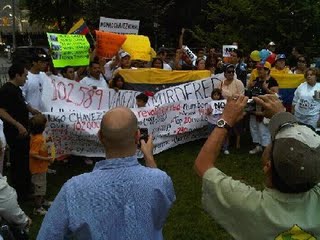
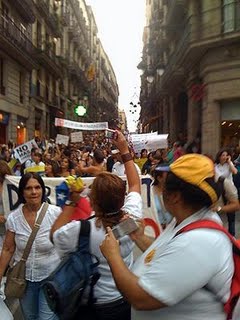


 Tenerife - Spain
 Barquisimeto - Venezuela
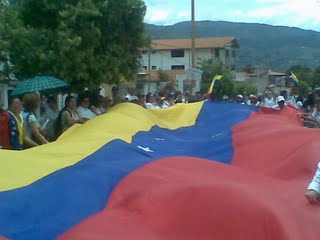 Merida Venezuela

