Friday, March 28, 2008

Human Rights Watch Video - Human Rights Violation in Venezuela

Video from Human Rights Watch, violations of Human Rights in Venezuela

Click here: http://www.youtube.com/watch?v=SxUNCqZoqMA

Labels: , ,

Wednesday, November 21, 2007

Students agreed today: they will vote NO!!!

The intention to abstain is still running high, however, and only a few of the opposition spokesmen have called on voters to go out and vote NO.
Distrust of the CNE continues to be strong, and the “reform” route is recognized by most as illegitimate, but the encouraging trend favoring the NO could change that soon.
In addition to Petkoff, Baduel and Ismael Garcia of PODEMOS, Manuel Rosales has now also called on voters to do so, and the students will take the same position on the occasion of their march this Wednesday 21.
The parties that are part of the hard liners in the opposition led by Antonio Ledezma, Oscar Perez, Oswaldo Alvarez Paz and Hermann Escarra continue, but probably not for long, to call for the cancellation of the referendum and abstention.
It appears increasingly likely that the “reform” proposal will not pass.
In such an event, but also in the case of a YES victory by a small margin, the political damage to Chávez will be irreversible. Last Friday the anti-government candidates in the elections to the student bodies of the UCV received more than 4 times the votes of the Chavista slate.
Chávez could however limit the damage to his hold on power and sidestep an unavoidable debacle by instructing the Supreme Tribunal of Justice to decide in favor of one of the sixteen requests before it to postpone or cancel the referendum.
However, Chávez also did say in a press conference to the foreign correspondents last week that “elections are just one strategic option in building socialism”.
Tampering with the electronic voting machines is not likely to represent a great temptation, even if no international observers will be present on 2 December. 50% of the ballot boxes will be opened and their contents checked against the numbers of the corresponding voting machines. Opposition parties and ngo’s are organizing a nation-wide operation combining exit polls and a quick-count (tasks that are mainly being organized by Un Nuevo Tiempo).
A large part of the population, quite possibly half of it, feels that it is about to lose its identity, values and very livelihood, and is decided to vigorously defend its rights under any circumstance. The other half is split 3 to 2 between those that feel Chávez is not a bad person but that he is slightly off the rocker, and those that love him passionately and fear that rejection of the reform proposal would lead to the loss of their recently acquired benefits and political priority.
But all generally agree that the “reform” proposal is not necessary to improve governance.
Victory of the YES would spell deep instability, and victory of the NO is certainly no guarantee of normalcy.
The “reform” is proving to be Chávez gravest political mistake since his first election to the Presidency, and regardless of the results of the referendum his government will have lost its legitimacy as of the evening of 2 December.
It will have been the result of a long and drawn out process that started even before his reelection last December, and which has been closely followed by the entire nation. This learning process bodes well for a relatively peaceful resolution of Venezuela’s grave crisis of governance.

Labels: , , ,

Friday, November 16, 2007

A constitutional 'reform' could complete Venezuela's transformation into a dictatorship.

Mr. Chavez's Coup. A constitutional 'reform' could complete Venezuela's transformation into a dictatorship.
Thursday, November 15, 2007; A24
TENS OF thousands of Venezuelan students marched to the Supreme Court in Caracas last week to protest the new "socialist" constitutional reform that President Hugo Chavez is preparing to impose on the country. On their return, students from the Central University of Venezuela were fired on by gunmen who roared onto the campus on motorcycles. Nine were hurt; university officials later identified the shooters as members of government-sponsored paramilitary groups. That's just one example of the ugly climate of intimidation Mr. Chavez is creating in advance of a Dec. 2 referendum that he expects will formally confirm him as de facto president for life and give him powers rivaling those of his mentor, Fidel Castro.
Mr. Chavez's apologists like to dismiss the Venezuelan forces opposing his deconstruction of democracy -- which include the Catholic Church, the private business community and labor unions as well as students -- as a corrupt elite. So it's worth noting what some of Mr. Chavez's long-standing allies are saying about his constitutional changes.
The political party Podemos, whose members ran for parliament on a pro-Chavez platform, call it "a constitutional fraud." Mr. Chavez's recently retired defense minister, Gen. Raul Isaias Baduel, said it was an "undemocratic imposition" and that its approval would amount to "a coup."
In fact, Mr. Chavez's rewrite would complete his transformation into an autocrat. It would lengthen his presidential term from six to seven years and remove the current limit of two terms, allowing him to serve indefinitely. He would have broad powers to seize property, to dispose of Venezuela's foreign exchange reserves, to impose central government rule on local jurisdictions and to declare indefinite states of emergency under which due process and freedom of information would be suspended. As a populist sop, one provision would reduce the workday from eight to six hours; that benefit, the state's control over national television and the voting process, and the apparent intention of many Venezuelans to stay away from the polls are expected to deliver the necessary ratification.
The strength and courage of the resistance to Mr. Chavez is nevertheless growing. Despite the attacks by government goons, students have continued to march by the thousands. Bloggers have posted photos and videos of the government-sponsored violence. Opposition leaders have continued to speak out despite being labeled "traitors" by Mr. Chavez and harassed with death threats. Venezuela is on the verge of succumbing to a dictatorship that will isolate and retard the country, maybe for decades. It's encouraging that so many of its people aren't prepared to give up their freedom without a fight.

Labels: , ,

Saturday, November 10, 2007

Crackdown in Venezuela Called a Ploy

Crackdown in Venezuela Called a Ploy. University Leaders See Move to End Campus AutonomyAssociated Press
Friday, November 9, 2007; Page A17


Police officers fired tear gas and rubber bullets at university students during a protest against President Hugo Chavez in Caracas yesterday


CARACAS, Venezuela, Nov. 8 -- University leaders accused the Venezuelan government Thursday of provoking violence to justify military occupations of campuses where students are leading protests against President Hugo Chávez.

Gunmen opened fire on students returning from a peaceful march Wednesday in which 80,000 people denounced a constitutional referendum, planned for December, that would expand Chávez's power. At least eight people were injured in the incident in Caracas, including one by gunfire, officials said.

Justice Minister Pedro Carreño blamed students, opposition leaders and the news media for the violence. "We want to urge the media to reflect, to stop broadcasting biased news through media manipulation, filling a part of the population with hate," Carreño said in an address Wednesday night.

Higher Education Minister Luis Acuña, meanwhile, offered to send in troops to quell the violence, but university authorities quickly rejected the offer as an attempted power grab.

"We won't fall into the trap," said Eleazar Narváez, rector of the Central University of Venezuela.

Chávez's opponents say the president has long wanted to end the autonomy of Venezuela's public universities, most of which are run by rectors associated with the opposition who defeated Chávez followers in campus elections.

Street demonstrations led by university students have spread to at least six cities around Venezuela, and organizers vowed to continue protesting despite crackdowns by security forces and clashes with government supporters. The marches have been mostly peaceful, although there have been several clashes in which students threw rocks and police fired plastic bullets at demonstrators.

On Wednesday, photographers for the Associated Press saw at least four gunmen -- their faces covered by ski masks or T-shirts -- firing handguns at a crowd of government opponents returning to the Central University of Venezuela from the march

Labels: , ,

Gunfire Erupts at Venezuela University

I am from Venezuela and this is true. The masked gunmen were sent by Chavez's political party. Our venezuelans students are heroes.Can you believe the "Justice Minister" blamed the marching students?
This article says: "the Supreme Court is unlikely to act on the students' demands, given that pro-Chavez lawmakers appointed all 32 of its justices".
vdebate

Gunfire Erupts at Venezuela University
CARACAS, Venezuela, Nov 08, 2007 (AP Online via COMTEX) -- Masked gunmen opened fire on students returning from a march in which tens of thousands of Venezuelans denounced President Hugo Chavez's attempts to expand his power through constitutional changes.
Officials said at least eight people were injured Wednesday, including one by gunfire, at the Central University of Venezuela, or UCV - the country's largest university.
Students protested in at least six other cities, and several turned violent with rock-throwing youths clashing with police shooting plastic bullets at demonstrators.
Photographers for The Associated Press saw at least four gunmen - their faces covered by ski masks or T-shirts - firing handguns at the anti-Chavez crowd at the UCV. Terrified students ran through the campus as ambulances arrived.
Antonio Rivero, director of Venezuela's Civil Defense agency, told Union Radio that at least eight people were injured, including one by gunfire, and that no one had been killed. Earlier, Rivero said he had been informed that one person had died in the violence.
The violence broke out after an estimated 80,000 anti-Chavez demonstrators - led by university students - marched peacefully to the Supreme Court to protest constitutional changes that would greatly expand Chavez's power if voters agree to the changes in December. Unrest, if it continues, could mar a Dec. 2 referendum on the controversial reforms.
Dozens of angry students surrounded a building where the gunmen were hiding, set fire to benches outside and knocked out windows with rocks. Later, armed men riding motorcycles arrived, scaring off students and standing at the doorway - one of them firing a handgun in the air - as people fled the building.
Justice Minister Pedro Carreno blamed students, university authorities, opposition parties and the media for the violence.
"We want to urge the media to reflect, to stop broadcasting biased news through media manipulation, filling a part of the population with hate," Carreno said in a televised address.
He did not provide details about the number of injured or if any suspects were arrested.
University students also staged demonstrations in the cities of Merida, Maracaibo, Puerto La Cruz, San Cristobal, Barquisimeto and Valencia on Wednesday.
The amendments being protested would abolish presidential term limits, give the president control over the Central Bank and let him create new provinces governed by handpicked officials.
The protesters demand the referendum be suspended, saying the amendments would weaken civil liberties and give Chavez unprecedented power to declare states of emergency.
"Don't allow Venezuela to go down a path that nobody wants to cross," student leader Freddy Guevara told Globovision during the march to the Supreme Court.
Chavez, who was first elected in 1998, denies the reforms threaten freedom. He says they would instead move Venezuela toward what he calls "21st century socialism."
In televised comments prior to the unrest, Chavez urged Venezuelans to turn out en masse to vote for the reforms. In reference to the opposition, he said: "Don't go crazy."
The Supreme Court is unlikely to act on the students' demands, given that pro-Chavez lawmakers appointed all 32 of its justices.
Copyright (C) 2007 The Associated Press. All rights reserved.

Labels: , ,

Thursday, November 8, 2007

Pictures Protest November 3, 2007 - Giancarlo


Students with chains


Herman Escarra


This is what Venezuelans think: Chavez=Coward, abusive, assassin, ...


Don't kill me


Liberty

Venezuelans


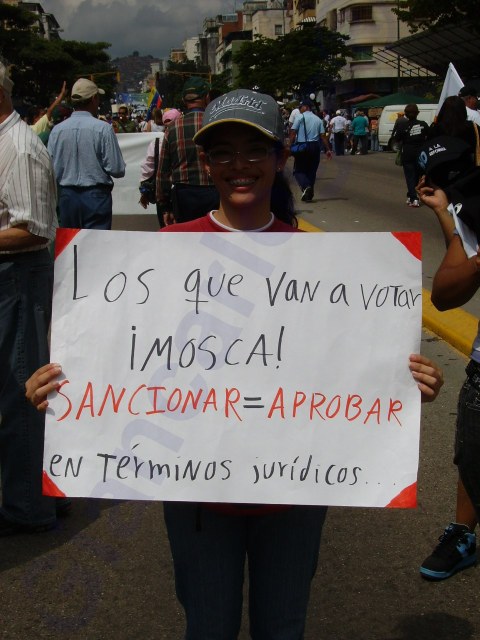
Sancionar=Aprobar

Police

Don't touch my kids, they are not alone

Labels: , , ,

Gunmen fire on Venezuela protest

These bad guys probably are part of Chavez political Party.
vdebate


Gunmen fire on Venezuela protest

Some of the gunmen opened fire on students from motorcycles
Gunmen in Venezuela have opened fire on students returning from a peaceful march in Caracas against President Hugo Chavez's planned consitutional reforms.
At least eight people were hurt during the clashes on a university campus, including at least one by gunfire.
The students were protesting against plans to remove presidential term limits, the subject of a referendum.
Thousands had marched to Venezuela's Supreme Court and filed a demand for the December vote to be suspended.
Last week, troops used tear gas and water cannon to disperse thousands of students protesting in Caracas against the proposed amendments.
Students fled
It is unclear how Wednesday's violence erupted.
A number of gunmen arrived at the Central University of Venezuela campus on motorcycles, law faculty dean Jorge Pabon told AFP news agency.
They set a bus alight, and later fired at students from inside one of the university buildings.
State TV showed footage of angry students setting fire to benches and throwing rocks at the university building where the gunmen were hiding.
Photographers for the Associated Press news agency saw at least four masked gunmen firing handguns at the crowd, as terrified students fled.
Globovision television, which is openly critical of the government, showed images of hooded men throwing objects into university classes and other people, apparently students, running away.
Civil defence chief Antonio Rivero said at least eight people were hurt, one of them by gunfire.
'Power grab'
The government described the protest, one of several recent student-led demonstrations against the constitutional reforms, as an opposition effort to destabilise the country ahead of the referendum on 2 December.
The amendments up for approval include giving the president control over the central bank, and the creation of new provinces governed by centrally appointed officials.
President Chavez is also proposing to bypass legal controls on the executive during a state of emergency, bring in a maximum six-hour working day, and cut the voting age from 18 to 16.
Supporters say the changes will deepen Venezuela's democracy but critics accuse Mr Chavez of a power grab.

More Pictures at:

Labels: , ,

Saturday, November 3, 2007

Troops Clash With Venezuelan Protesters

We admire all these Venezuelan' students protesting against our dictator Chavez. Chavez will win the elections on December 2nd, because of ELECTRONIC FRAUD IN OUR VENEZULAN'S ELECTIONS!!!!!
vdebate reporter

Riot police officers protected themselves Thursday as university students protested in Caracas, Venezuela.

By THE ASSOCIATED PRESS
Published: November 2, 2007


Troops Clash With Venezuelan Protesters
CARACAS, Venezuela (AP) -- Soldiers used tear gas, plastic bullets and water cannons to scatter tens of thousands who massed Thursday to protest constitutional reforms that would permit Venezuelan President Hugo Chavez to run for re-election indefinitely.

Led by university students, protesters chanted ''Freedom! Freedom!'' and warned that 69 amendments drafted by the Chavista-dominated National Assembly would violate civil liberties and derail democracy.

It was the biggest turnout against Chavez in months, and appeared to revive Venezuela's languid opposition at a time when the president seems as strong as ever. Students promised more street demonstrations over the weekend, but no opposition-led protests were planned for Friday.

''This is a dictatorship masked as democracy,'' said Jorge Rivas, an 18-year-old student. ''Chavez wants our country to be like Cuba, and we're not going to allow that to occur.''

Authorities broke up the protest outside the headquarters of the country's electoral council, reporting that six police officers and one student were injured. But students said dozens of protesters were hurt during the melee. The local Globovision television network broadcast footage of several police beating an unarmed protester with billy clubs.

Student leader Freddy Guevara said it was not immediately clear how many students were arrested, and he urged local human rights groups to help verify the number of detained protesters.

Students hurled rocks and bottles, and a few lifted up sections of metal barricades and thrust them against police holding riot shields. Students retreated later when police fired plastic bullets.

Rock-throwing clashes between students and Chavez supporters continued at a nearby university campus.

''Chavez wants to remain in power his entire life, and that's not democracy,'' said Gonzalo Rommer, a 20-year-old student who joined protesters marching to the National Elections Council.

Deputy Justice Minister Tarek El Aissami blamed students for the violence, saying they forced their way through police barricades.

But Vicente Diaz, one of the National Election Council's five directors, accused National Guardsmen and police of using excessive force to disperse protesters. ''We absolutely condemn the behavior of the authorities,'' Diaz said.

The amendments would give the government control over the Central Bank, create new types of cooperative property, allow authorities to detain citizens without charge during a state of emergency and extend presidential terms from six to seven years while allowing Chavez to run again in 2012.

To take effect, the reforms must be approved by voters in a Dec. 2 referendum. Lawmakers are expected to give final approval to the amendments on Friday during a special congressional session.

Opposition parties, human rights groups and representatives of the Roman Catholic Church fear civil liberties would be severely weakened under the constitutional changes.

Chavez, a close ally of Cuban leader Fidel Castro, denies the reforms threaten civil liberties.

He and his supporters say the changes will help move the country toward socialism, while giving neighborhood-based assemblies more decision-making power in using government funds for local projects like paving streets and building public housing.

Labels: , , ,

Friday, November 2, 2007

Students protest against changes in the constitution

I am glad that Venezuelan students are protesting against the changes that Chavez wants to do in our Venezuelan Constitution. He just wants "TOTAL POWER"

Here Maria Conchita Alonso talking to FOX NEWS:

http://cosmos.bcst.yahoo.com/up/player/popup/?rn=3906861&cl=4839407&ch=4226714&src=news

Labels: , , ,

Tuesday, June 26, 2007

Venezuelan Student in Washington - Geraldine Alvarez

For release at will

Press advisory: Venezuelan Students seeking to protect Freedom of Expression and other Civil Liberties will discuss deterioration of democracy in Venezuela

Sponsored by: The National Press Club Newsmaker Committee
Friday, June 29, 9:00-10:30 AM

Contact: Carla Bustillos, Cell phone: (202) 415-2370; Alt cell phone: (202) 277-6627. E-mail bustillos.carla@gmail.com

Geraldine Alvarez, a student from the Universidad Católica Andres Bello and one of the leaders of the Venezuelan Students Movement, will address at the National Press Club, 529 14th Street NW. Washington, DC 20045, Friday, June 29, 9:00-10:30 AM, the progressive erosion of civil liberties in Venezuela and will explain the objectives of the student movement that has taken the lead in the struggle to counteract the government's efforts to limit free speech, the right to protest and University autonomy. The student movement she represents was galvanized by the recent unlawful closure of the country's oldest and most watched TV station: Radio Caracas Television (RCTV).
Ms. Alvarez's presentation will be complemented by observations made by experts in the fields of human rights, Latin American politics and academia who will provide additional details of the current state of Democracy and Human Rights in the country.
· Thor Halvorssen, President of Human Rights Foundation, who will speak on the works of his organization covering cases in Venezuela where individuals have been persecuted and jailed for expressing their views or exercising their rights to free speech.
· Roberto Izurieta (TBC), Director of Latin American Projects for The Graduate School of Political Management, The George Washington University, who will give a scholar analysis on the situation of freedom of expression, academic freedom and overall democracy in Venezuela.

This event will be sponsored by the National Press Club Newsmaker Committee with the coordination of Lucha Democrática. Moderating the panel will be Peter J Hickman of NPC. Carla Bustillos from Lucha Democrática (Restore Democracy) and Venezuelan Students Abroad-Washington, D.C. will give opening remarks and panel introduction. Lucha Democrática is an organization established in 2001 by Venezuelan citizens residing or studying in the Washington, DC area, to highlight Governmental abuse and threats to Venezuelan democracy.

Labels: , ,

Wednesday, June 20, 2007

The Copa America

The Copa America will start this coming June 26th. The students will be protesting against Chavez government showing, that they don't agree with Chavez politics. Three weeks ago, Chavez government closed a TV channel that criticized him. He doesn't want any media talking bad about him. He has been the worse Venezuelan president ever. I wish the Venezuelans succeed in their protest again his government. By the way, the tickets to the Copa America, soccer events where sold only to people that work for the government. Chavez was afraid that people will protest him in from of foreign media. Check this cartoon: http://www.blog.vdebate.org/2007/06/from-economist-today.html.

Labels: , ,

Sunday, June 17, 2007

Chavez on Every Channel

May 29, 2007
By Jens Glüsing in Rio de Janeiro
For Venezuelan President Hugo Chavez, television is the ultimate instrument of power. Now, despite every protest, he has let the license expire for RCTV, a private station that has long been critical of the government. The country's last remaining opposition channel must now fear for its future, too.
Using water cannons, tear gas and rubber bullets, the police used brute force against the close to 5,000 protesters. They had gathered on Monday to protest the shutdown of private TV channel Radio Caracas Television (RCTV), which had been critical of the government. Afterwards, small groups of demonstrators engaged in skirmishes with the police in several locations in the Venezuelan capital. At least three demonstrators and one policeman were injured.
Protests also occurred in the university town of Valencia on Monday. Four students were injured. At the protest rally in Caracas, RCTV anchorman Miguel Angel Rodriguez called out: "They will not silence us!" But the new public TV channel Tves was already broadcasting on RCTV's former frequency by then.

Go to the following link and see the complete article of "Chavez on every Channel"

http://www.spiegel.de/international/world/0,1518,485461,00.html

Labels: ,

Saturday, June 9, 2007

Students Continue Protest in Venezuela

A Bid to Ease Chavez's Power Grip
Students Continue Protests in Venezuela
President Threatens Violence
By Jose de Cordoba

The Wall Street Journal via Dow Jones
Caracas, Venezuela -- A student movement that has swept across Venezuela is posing a strong challenge to President Hugo Chavez's drive to extinguishindependent power centers in the universities and media.
Although Mr. Chavez continues to have a firm grip on the government, the student protests have demonstrated a broad uneasiness with his efforts todominate Venezuelan society.

Mr. Chavez's approval ratings have fallen and suspicion of his intentions has grown among Venezuelans. He also hasn't responded to the protests in a way that resonates with the public, many of whom view the students with sympathy. Instead, he has threatened to use violence to put down the demonstrations. InVenezuela, as in most Latin American countries, students have played an outsized political role, including in the country's transition to democracy in 1958.

Since he was first elected president in 1998, Mr. Chavez has brought to heel a number of once independent power centers in Venezuela - notably the oil industry, judiciary, military and legislature. The university system and a quickly diminishing sector of the Venezuelan media are among the few important institutions outside the ambit of his control.
The student protests were sparked by the closure in late May of an opposition television station, Radio Caracas Television, or RCTV. The students seek toconvince Mr. Chavez to give up plans to remake Venezuela's educational system.The closure of RCTV appeared to convince the students that Mr. Chavez meant business when he announced a plan to create a "revolution within the university." Students and professors fear that would mean an end to university autonomy and an imposition of Cuban-style socialist ideology.

"Mediocrity is what they want," says Carolina Rondon, who studies physical therapy in Caracas at the Central University of Venezuela, the country's largest university, as she prepared to join tens of thousands of other students on a protest march Wednesday. "We are marching to save our future." On the side of a building, a huge banner had just one word: "Freedom."

Student organizers have been careful to portray their movement not as antiChavez, but as pro-freedom of expression, and have kept their distance from the largely discredited leaders of Mr. Chavez's political opposition. Shunning violent confrontation, students have adapted tactics such as handing grim-faced riot police red carnations. One day this week, groups of students with their mouths taped shut rode the city's subways holding signs that said "Peace," and "Tolerance."

To help keep their plans secret from police and the National Guard, which hastried to keep students bottled up at different universities, student organizers use cellphone text messaging to spread the news on future protests.

The number of Venezuelans who have a favorable opinion of the president has fallen 10 percentage points to 39% since November, according to Hinterlaces, a Caracas pollster. Skyrocketing crime, inflation and shortages of basic food shave contributed to Mr. Chavez's fall in popularity since he won re-election by a landslide in December.
In the past, Mr. Chavez, who has spent billions of dollars on social-welfare programs aimed at the poor, has deftly manipulated Venezuela's sharp class divisions to portray his foes as U.S. manipulated "oligarchs."

That tactic hasn't worked this time, as students come from all walks of life and many are poor or working class. "You see all kinds of students here. There are no 'oligarchs,'" says Pamela Lora, a 20-year-old public-health student at UCV. "This has nothing to do with President Bush or with any 'empire,'" she scoffs.

The Chavez government has wavered in its response. After using tear gas and rubber bullets to break up student demonstrations last week, police have moderated their approach. On Wednesday, students were able to deliver their complaints personally to Attorney General Isaias Rodriguez, a Chavez hard-liner.

The state television network, which usually ignores anti-Chavez protests, broadcast the encounter. Mr. Rodriguez listened as student leader Eduardo Torres lectured him: "We are not delinquents, we are democrats and will stay on the streets."

The following day, student representatives delivered a message to Congress, which consists entirely of Chavez supporters because the opposition didn'tcontest the last legislative election.

Even some Chavez allies in the legislature are expressing dissatisfaction with the president's efforts to consolidate power.

But Mr. Chavez hasn't for sworn threats in dealing with the students, who he has accused of being the dupes of a U.S. plot to destabilize his government. At an hours-long press conference Wednesday, Mr. Chavez threatened to lead "the people" in about of "Jacobin revolutionary violence" against students.

Despite his slide in popularity, Mr. Chavez maintains a strong grip on power which the students will have a hard time loosening. Since 1998, Mr. Chavez has survived a short-lived coup and a two-month strike in the state-owned oil company, Petroleos de Venezuela SA, known as PDVSA. Along the way, he has purged the army and has used PDVSA as a piggy bank to fund his ambitious social-welfare program.

Mr. Chavez also controls the country's electoral system, judiciary and legislature.
Since he was re-elected in December, Mr. Chavez has moved against privatefirms, nationalizing Venezuela's main telephone company and power company whilewresting control of billion-dollar projects from foreign oil firms.

The student protests began after Mr. Chavez refused to renew the broadcastlicense of RCTV, arguing that the outlet had tried to destabilize his government, been disrespectful of authority and endangered children's morals by showing spicy programming. A Hinterlaces poll showed about 80% of Venezuelans opposed the closure, which also unleashed a barrage of international and domestic criticism. Since then, Mr. Chavez threatened to cancel the license of Globovision, the sole remaining broadcaster that is critical of his rule.

Now, neither Mr. Chavez nor the students seems certain what to do next. Venezuela is scheduled to host teams from the hemisphere for the Copa America soccer tournament this month and would want to avoid scenes of police clashing with students broadcast across Latin America. He may be hoping that protests will peter out as students face final exams and leave on summer vacation.

The students aren't sure how far to take their protests either. This week, at daily morning planning meetings in every university in Caracas, students debated how to balance academic concerns and political action. "I'm prepared to lose a year of my career and two months of classes in exchange for the future we will build," said one ponytailed student delegate at an assembly at Andres Bello Catholic University this week, to a thunderous round of applause.

Peter Millard contributed to this article.

Labels: , ,